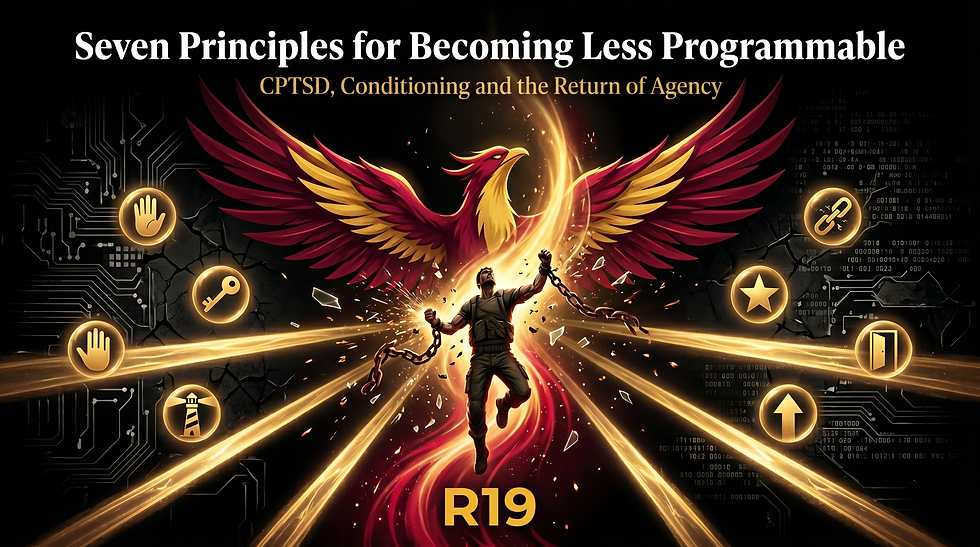
Seven Principles for Becoming Less Programmable

Updated: Jun 23
CPTSD, Conditioning and the Return of Agency
Most people do not lose their power in one dramatic collapse.
They lose it in fragments.
They lose it in the first five minutes of the morning, before their feet even hit the floor, when they reach for the phone before they reach for themselves. They lose it explaining themselves to people who were never listening in good faith. They lose it in emotional reactions that were understandable, but strategically destructive. They lose it scrolling through digital sewage: breakfast updates, toilet feelings, shoe choices, synthetic outrage, curated virtue, and other meaningless signals dressed up as social life.
They lose it in relationships that feel familiar, but quietly shrink them. They lose it in comfort patterns that look like rest, but are really avoidance wearing soft clothes and shallow sentiments. The deeper loss is not distraction. It is conformity.
Conformity rarely announces itself as submission. It arrives as routine. Politeness. “Keeping the peace.” Laughing along when something inside you recoils. Saying yes with a body that is screaming no. Staying in relationships where the nervous system is constantly braced, because the pattern is familiar enough to be mistaken for belonging.
This is where conditioning enters.
A human being does not become compliant by accident. They are trained into it. By family. By school. By workplaces. By institutions. By intimate relationships. Increasingly, by the social-engineering algorithms of app culture itself: a behavioural machine that keeps people addicted, distracted, seduced by digital gibberish, intoxicated by noise, and trained into weakness — available, agreeable, visible, measurable, reachable, reactive, emotionally convenient, compliant, conforming, and easily controlled, all while mistaking their cage for freedom.
For a person living with complex trauma, this is not weakness. It is the residue of survival.
Complex post-traumatic stress disorder is not simply “stress after a bad event.” It is the deep adaptation of the nervous system, identity and relational world after prolonged exposure to threat, abandonment, humiliation, coercion, betrayal or danger. The ICD-11 model describes CPTSD as PTSD plus disturbances in self-organisation: emotional regulation difficulty, negative self-concept and relational disturbance.
In plain English, the wound does not stay inside memory.
It spreads into how a person feels.
Thus, for someone with complex trauma, this becomes more than social pressure.
It becomes a control prison nightmare. Conformity can land on a nervous system already trained by threat. If disagreement once brought punishment, the body learns silence. If saying no brought abandonment, the body learns appeasement. If visibility invited attack, the body learns to shrink. So when culture says “fit in,” the trauma body hears “survive.” When the app says “stay connected,” the wounded nervous system hears “stay available or be forgotten.”
That is the trap.
Compliance is not weakness. It is often survival residue. But what once protected a person in danger can later imprison them in freedom. CPTSD recovery is therefore not just feeling better. It is becoming less conditioned, less compliant, less controlled, less programmable — and finally free enough to choose.
Who they believe they are. Whether other people feel safe. Whether silence feels peaceful or dangerous. Whether disagreement feels ordinary or catastrophic.
Whether love feels secure, or like a contract that can be withdrawn at any moment.
Judith Herman described the core experiences of psychological trauma as “disempowerment and disconnection.” That is the heart of CPTSD. Repeated harm disconnects the person from safety, from trust, from others, and often from themselves.
So the question is not merely: how does a traumatised person feel better?
The sharper question is: how does a traumatised person become less programmable?
Less programmable by fear. Less programmable by shame. Less programmable by other people’s moods. Less programmable by the algorithm. Less programmable by institutional pressure. Less programmable by the old internal command to comply, explain, shrink and survive.
That is where the seven principles matter.
Not as fake dominance. Not as macho theatre. Not as emotional numbness dressed up as strength, but as a recovery architecture.
Seven principles for the return of agency.
Principle One - Own the First Hour
The first hour of the day is not just time. It is nervous-system territory.
Many trauma survivors wake into threat before they wake into thought. The body comes online already scanning: messages, danger, tone, rejection, conflict, obligation, mood, risk. The phone becomes less a tool and more a threat portal. Notifications become tiny alarms. Headlines become manufactured dysregulation. Social media becomes comparison, surveillance, outrage and artificial urgency before the self has even arrived.
If the algorithm gets there first, the day begins with colonisation.
Owning the first hour is not productivity advice. It is self-restoration.
It says: before the external world gets access to my attention, my attention belongs to me.
For CPTSD, this matters because the nervous system is easily pushed outside its window of tolerance. Above the window is hyperarousal: panic, anger, anxiety, vigilance, flooding. Below it is shutdown: numbness, fog, collapse, dissociation. Inside the window, a person can think, feel, choose, connect and respond.
The first hour widens the window.
Silence. Breath. Movement. Cold water. Journalling. Prayer. Reading. Planning. Sitting outside. No phone. No news. No emotional ambush.
Do not let the algorithm become your first attachment figure of the day.
That is not softness. That is command.
Principle Two - Master Silence
Silence can punish. Many people with CPTSD know that silence well: the silent parent, the silent partner, the silent institution, the silent room before judgement arrives.
But chosen silence is different. Chosen silence is not fear.
It is boundary.
Many trauma survivors over-explain because being misunderstood once carried consequences. Explanation becomes a survival ritual. A courtroom defence. A way of trying to purchase fairness from people who may not be capable of giving it.
They explain to reduce danger. They explain to prevent abandonment.
They explain to prove they are good. They explain because the body believes clarity might finally make the unsafe person safe. But some rooms do not want clarity.
Some rooms want access. Some people ask questions not to understand, but to locate weakness, extend control, exhaust the nervous system, or bait a reaction.
This is where silence becomes medicine.
Chosen silence says: I do not need to hand everyone a map of my wounds. I do not need to perform my pain to make it real. I do not need to explain myself into exhaustion.
“No” can be a sentence.
“I’m not discussing that” can be a complete act of self-respect.
Silence is not avoidance when it protects dignity.
It is containment.
And containment is one of the foundations of recovery.
Principle Three - Develop Emotional Regulation
Feelings are information. They are not instructions.
This principle is central because trauma makes the nervous system fast. It does not make people irrational. It makes the body react before the thinking brain has finished reading the situation.
A look becomes rejection. A delay becomes abandonment. A raised voice becomes danger.
A closed door becomes punishment. A disagreement becomes exile.
The reaction may feel immediate because internally it is not responding only to the present. It is responding to the present plus every stored echo of the past.
Bessel van der Kolk wrote that trauma can organise life as if the trauma were still happening. That is CPTSD in one sentence. The past does not merely sit behind the person. It leaks into the present.
Emotional regulation is not “calming down” as a moral lecture. It is restoring sequence.
Notice the body. Name the feeling. Identify the trigger. Delay the reaction.
Choose the response that serves the mission, not the wound.
Anger may signal violation. Fear may signal perceived threat. Shame may signal an old wound. Grief may signal that something mattered. But no feeling automatically knows the correct next move.
A traumatised nervous system often confuses intensity with accuracy. The louder the feeling, the truer it seems. But intensity is not proof.
It is volume. Emotional regulation does not say, “I must not feel this.”
It says, “I can feel this without obeying it blindly.”
The goal is not to become cold. The goal is to become free.
Principle Four - Practise Strategic Invisibility
The modern world confuses visibility with significance.
Post it. Prove it. Announce it. Perform it. Explain it. Display it. Defend it. Turn the inner life into public content and call it authenticity.
But healing does not always need an audience.
For people with CPTSD, visibility carries a double charge. Being seen may feel like justice: finally, someone will know what happened. But being seen may also feel dangerous: exposure, judgement, attack, disbelief, ridicule, retaliation.
So the traumatised person can become trapped in a loop: reveal, regret, explain, defend, delete, crave recognition, fear scrutiny, then feel unseen all over again.
Strategic invisibility offers another path.
It is not hiding. It is not shame. It is not silence forced by fear.
It is the deliberate protection of growth before it is strong enough to withstand public weather.
Some transformations need darkness the way seeds need soil. If every early movement is exposed to commentary, pressure or mockery, the growth can be damaged before it becomes rooted.
Strategic invisibility asks:
Who am I when I am not defending myself?
What do I want when I am not performing strength?
What am I building that does not require immediate applause?
The modern world rewards exposure.
Healing often requires privacy.
Not every chapter needs witnesses.
Some chapters need roots.
Principle Five - Invest in Yourself Ruthlessly, But Not Cruelly
CPTSD often steals the future.
It trains the person to survive the next hour, the next mood, the next threat, the next conflict, the next collapse. Long-term development becomes difficult because the body is living in emergency economics. There is no spare energy for growth when all energy is spent on threat management. That is why self-investment is not motivational fluff. It is identity reconstruction.
Reading. Training. Therapy. Skill-building. Reflection. Study. Creative practice. Financial repair. Health routines. Disciplined rest. These are not aesthetic upgrades.
They are acts of self-return.
They say: I am not only what happened to me. I am not only my reactions. I am not only my losses. I am a person under construction.
But self-investment must be ruthless without becoming cruel.
There is a dangerous version of self-improvement that simply recreates abuse internally. It shames, bullies, compares and demands. It says: you are worthless unless you perform.
That is not growth.
That is the old wound becoming a life coach.
Healthy self-investment is firm and compassionate.
It says: we are going to build. We are going to stop abandoning ourselves. We are going to do difficult things, not because we hate who we are, but because we are done living beneath what survival forced us to become.
Punishment attacks the self. Discipline protects the future. Know the difference.
Principle Six - Eliminate Weak Alliances
The nervous system learns through relationship.
Safe people help the body settle.
Unsafe people keep it braced.
This is why relational discernment is not optional for CPTSD recovery. It is central. Relationship disturbance is not a side effect of complex trauma. It is one of its core features.
The survivor may trust too quickly, or not at all. They may cling to unsafe people because familiarity feels like love. They may tolerate disrespect because abandonment feels worse. They may confuse intensity with intimacy, rescue with connection, loyalty with self-erasure.
This is why relationship auditing matters.
A weak alliance is not simply a person who struggles. Everyone struggles. A weak alliance is a pattern that repeatedly pulls you away from clarity, dignity, stability or growth.
The person who mocks your progress.
The person who only feels close when you are broken.
The person who drains you, then calls your exhaustion selfish.
The person who uses your trauma history as a lever.
The person who demands access but offers no safety.
The person who benefits from your dysregulation.
Eliminating weak alliances does not always mean dramatic exits. Often it means reducing access.
Less disclosure.
Less immediacy.
Less rescuing.
Less explaining.
Less emotional labour.
Less availability.
This is not cruelty.
This is nervous-system governance.
The question is not merely, “Do I love this person?”
The better question is: who do I become in this pattern?
Smaller? More anxious? More reactive? More ashamed?
Or clearer, steadier, freer, more myself?
The body often knows before the mind admits it.
Listen.
Principle Seven - Use Adversity as the Forge — Without Worshipping Suffering
Pain can shape a person. But pain is not automatically wisdom.
This distinction matters. Trauma survivors are often told to turn suffering into strength before anyone has fully acknowledged the cost. That can become another form of silencing. Another demand to make harm useful. Another pressure to become inspirational so others do not have to sit with the reality of what happened.
Adversity can forge.
But suffering should never be worshipped. Unprocessed pain repeats itself.
Processed pain becomes information. Integrated pain becomes depth.
Shared wisely, it can become service. The forge is not the trauma.
The forge is what the person does after.
Therapy. Reflection. Boundaries. Anger made clean. Grief made speakable. The body slowly learning safety. The story becoming coherent. The self returning from exile.
Post-traumatic growth is real, but it must never be used to minimise harm. No one should be grateful for being harmed. No one should be told abuse was a gift. No one should be forced to turn devastation into meaning before they have been allowed to grieve.
The mature principle is this:
This happened.
It mattered.
It changed me.
But it does not get to own the rest of my life.
That is not denial.
That is authorship.
The Integration - From Conditioning to Consciousness
The seven principles are not separate tricks.
They form a recovery architecture.
Owning the first hour protects the nervous system. Silence protects boundaries. Emotional regulation protects judgement. Strategic invisibility protects growth. Self-investment rebuilds identity. Relational auditing protects attachment and energy. Adversity integration turns pain into meaning without glorifying harm.
Together, they answer the deeper wound of CPTSD: the loss of agency.
Trauma teaches the body that life happens to you.
Recovery teaches the body, slowly and repeatedly, that you can participate again.
You can choose. You can pause. You can leave. You can speak. You can be silent. You can build. You can rest. You can protect yourself without becoming cruel. You can be strong without becoming unreachable. You can remember without being ruled by memory.
That is power over comfort.
Not the childish power of control over others.
The adult power of command over oneself.
The real goal is not rebellion for its own sake. That is just another costume.
The goal is to become conscious enough to choose.
To cooperate when cooperation is aligned with dignity.
To walk away when belonging requires self-erasure.
To speak when truth is required.
To stay silent when explanation would only feed the machine.
To rest when the body needs restoration.
To act when comfort has become a cage.
This is the movement from conditioning to consciousness.
From conformity to agency.
From survival reflex to chosen response.
From CPTSD as a prison of old adaptations to recovery as the slow, disciplined return of authorship. The world will still try to train you. It will train you to scroll, consume, obey, compare, perform, panic, explain and remain available for endless interruption. It will reward compliance and call it maturity. It will punish boundaries and call them selfishness. It will mistake your healing for arrogance when you stop being so easy to access, guilt, provoke and shrink. Let it misunderstand.
A person recovering from complex trauma is not becoming difficult.
They are becoming less conditioned.
And to every system, relationship or culture that benefited from their fragmentation, that will always look like rebellion. But it is not rebellion.
It is return. The strongest person is not the one who feels nothing.
The strongest person is the one who can feel deeply and still choose wisely.
The one who can stand in the old storm and say:
I know this weather. I survived it before.
But I no longer have to build my home inside it.
That is the Emberline principle. Pressure may shape you.
Pain may teach you. But neither gets to name you. You are not being born. You are being rebuilt.



Comments